Category Archives: Museums

Make Your Own Season’s Greetings at the National Postal Museum


If you haven’t yet been to a card-making event at the National Postal Museum (or even if you have), then mark your calendar for this fantastic holiday activity: The Annual Holiday Card Workshop will be held Saturday and Sunday, December 8-9, from 10am – 4pm. And I can tell you from firsthand experience that these open-house events at the Postal Museum are always perfect for all ages, well-organized, festive, and super fun.

All of the supplies is provided — a bountiful spread of patterned papers, postage and rubber stamps, gems and other 3-D embellishments, special cut-out scissors, washi tape, stickers, markers of every color, and more! Following their own creative instincts, kids (and adults, for that matter) can choose whichever supplies they would like to design one-of-a-kind greetings for any holiday, or even just a wintery “Hello!”

Once finished, cards can then be placed in envelopes, addressed, and adorned with a distinctive National Postal Museum postmark at the museum’s stamp store. In keeping with educating children about the postal service and how mail works, kids can pop their own cards in an official USPS mailbox that is decorated to exactly resemble — none other than –SpongeBob SquarePants! Of course, visitors should also explore the whole museum and everything else it has to offer — you can read more about it all here.

The workshop takes place in the museum’s lower-level Atrium, which is full of various postal transports from over the years, including a real train car, semi-truck (yes, kids can climb in and pretend to drive!), a horse-drawn carriage, and airplanes hanging from the ceiling. Thanks to Smithsonian Gardens, the Atrium will be decked out in festive foliage, as well!

The layout of the card-making stations and supply tables encourages sharing, friendliness, and a sense of community, particularly important in this day and age. And the museum’s friendly staff and volunteers are always available to answer questions, provide examples of completed cards, or help in any other way!

So, remind children of the real reason for the season: Giving! And impart in them the tried and true lesson: It’s the thought that counts. Sometimes a handmade gesture can mean so much more to a friend or a loved one than any store-bought gift. What better way to get into the holiday spirit than taking the time to express your love and gratitude for the important people in your life with a heartfelt greeting?

Annual Holiday Day Card Workshop
Where: National Postal Museum | 2 Massachusetts Ave NE, WDC
When: December 8-9, 10am – 4pm
Admission: Free


This post is sponsored by the National Postal Museum, however, I only promote events, places, and programs that I genuinely believe in and think will be of interest to KFDC readers.


Leave a Comment

Filed under 2018, All ages, Annual, DC, Free, Holidays, Museums, Seasonal, Special Event, Sponsored Post, Weekend, Winter

The Hirshhorn’s Newest Exhibit Will Capture Your Heart


A new exhibit at the Hirshhorn will capture your heart — literally, you might say. Pulse, created by artist Rafael Lozano-Hemmer, combines science and art in the museum’s largest interactive technology exhibition ever. It’s beautiful, unique, thought provoking, and so interesting. And it offers an experience that all ages can appreciate in some way.

Requiring visitor engagement, Pulse is comprised of three large-scale installations that use heart rate sensors to produce audiovisual experiences from visitors’ own biometric data. That’s right, your heartbeat — along with those of other museum-goers — helps generate many of the scenes and sounds throughout the exhibition. Visitors’ fingerprints play a big part in it, too.

The works were inspired by the heartbeats of Lozano-Hemmer’s own fraternal twins when they were still in the womb. He asked for two ultrasounds to listen to both at once and was moved by their distinct pulses that “began phasing in and out, creating new complex sounds.” He wanted to make the differences visible with his art and turn them into immersive experiences that don’t just illustrate the metrics of the heart, but also, as Lozano-Hemmer put it during the media preview, “remind us of the fundamental metrics of humanity.”

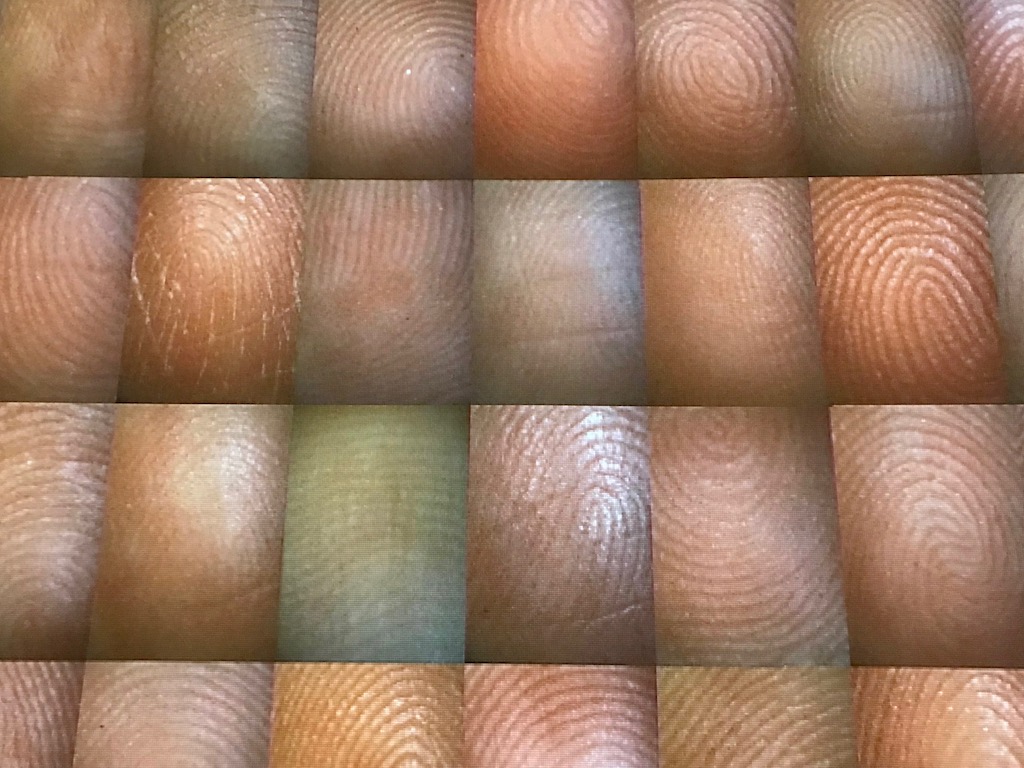
Taking up the entire second floor of the Hirshhorn, the exhibition begins with Pulse Index, which records participants’ fingerprints (along with their heart rates) and projects them along one wall. There are 10,000 of them, beginning with one giant image of the last print recorded, then more smaller images of previous prints that reduce in size as they move along the wall. Every time a new print is recorded, one is deleted from the other end, a metaphor for the human life cycle. It’s arresting to see all of the individual identities in one sweeping projection. Lozano-Hemmer also noted that creating this landscape of fingerprints — which are usually used to track and identify — and making them into art, symbolically breaks up the control of our current identification systems.

In the next room, Pulse Tank presents several illuminated water tanks throughout the room with heart rate sensors connected to them. Visitors interact with the sensors by inserting a finger or placing palms on a surface. Computers then detect their pulse and tap ripples into the water, and the patterns are reflected onto the wall. Essentially, you can see your heartbeat as shadows and light and watch it move along the wall, sometimes intersecting with those of other visitors, but each of them unique.

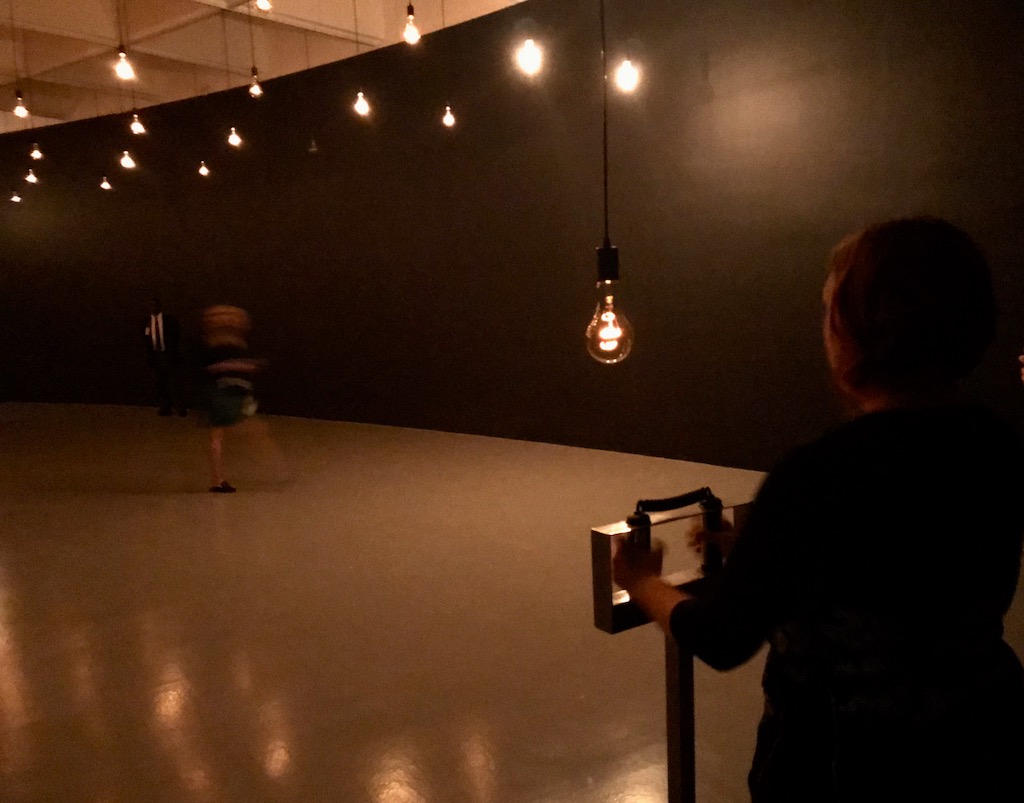
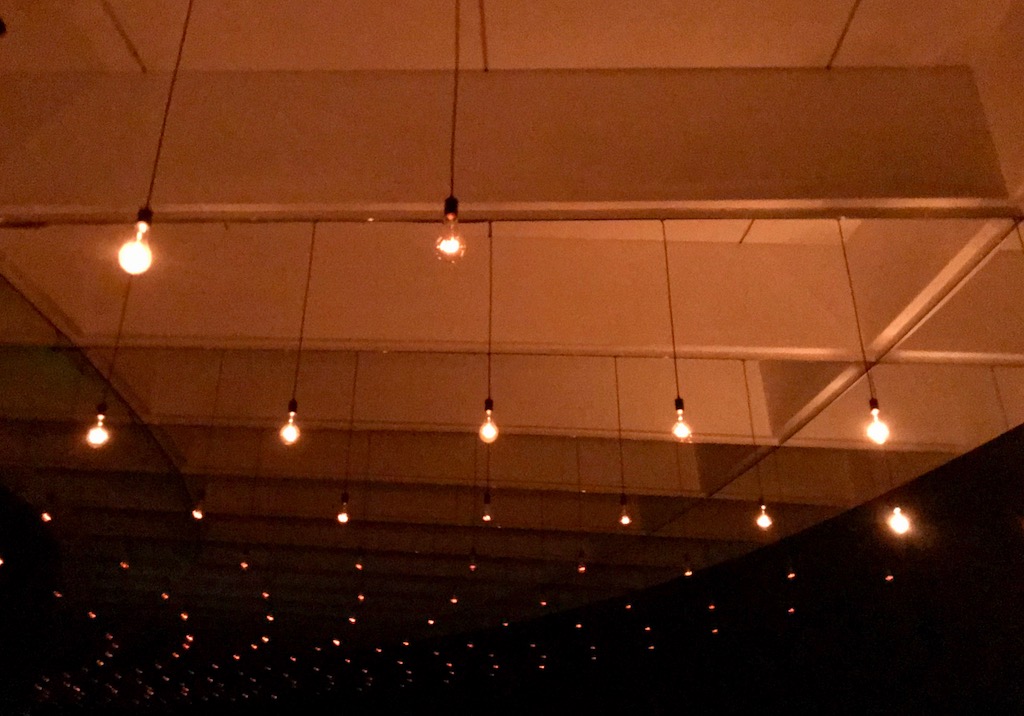
The final installation, Pulse Room, kind of has a disco feel to it with 200 flickering incandescent light bulbs hanging from the ceiling in the dark gallery with a reddish-orange hue. There’s a low rumbling that almost sounds like the build-up of something larger that never comes to fruition. You (or at least I did, anyway) realize later that each light bulb represents a heartbeat, and that rumbling sound is 200 of them playing at once. A sensor on the far side of the room lets you add your heartbeat to the mix. It starts with the first bulb, which blinks with your heart rate. Like the fingerprints, as a new heartbeat is added, the rest move to the next bulb, the last one dropping off — again, signifying the cycle of life. It’s at once moving and enchanting, uplifting but also a little bit grim as we’re reminded that we’re all in this together, though — in the broad spectrum of the universe — our time here is fleeting.

Pulse is likely going to be a popular exhibition, and there may be lines to interact with it and use the sensors. But unlike previous exhibits with waiting times, in this one you can still immerse in and enjoy the art created by Rafael Lozano-Hemmer — and everyone interacting with his work — while you wait, since the results are all around you. That seems fitting for an exhibit that, in many ways, illustrates our collective experience as human beings.

Kids are very welcome to Pulse — Lozano-Hemmer has three himself and says that children often change the environment of the room, making it more lively and playful than the somber feel of just adults. And while young children may not understand the underlying meaning of the works, they will enjoy interacting them and, hopefully, experience a sense of wonder.

Pulse will be at the Hirshhorn through April 28, 2019. Museum hours are 10am – 5:30pm. Admission is free.


Leave a Comment

Filed under 2018, 2019, All ages, Art, DC, Exhibit, Fall, Free, Museums, Spring, Weekdays, Weekend, Winter

Programs for Little Learners at the Smithsonian Early Enrichment Center

An SEEC Toddler Trailblazers workshop

[Note: This is a Sponsored Guest Post contributed by Cynthia Raso, Director of the Office of Engagement at the Smithsonian Early Enrichment Center (SEEC).]

People are often surprised to learn that there’s a school at the Smithsonian. The Smithsonian Early Enrichment Center is a small school for infants through Kindergartners that opened its doors over 30 years ago. We acknowledge that children of all ages are capable learners, and we operate from the core belief that children benefit from learning in museums.

Over the years, we have developed a unique approach to learning beyond the classroom. Today, community is at the heart of what we do. We believe that by learning in the community children can better understand concepts and experience more of the world. We also believe that by supporting a community of families, we can create a framework that will enhance a child’s overall growth and development.

CREATING COMMUNITY
Life is hectic, so we invite families to slow down when they enter our classrooms. We begin most of our classes by playing and we encourage our caretakers to interact with the children and adults in the room. We find that this period can be meaningful time spent with your child as well as a chance to socialize and meet other families. The best part of our play is that the SEEC team does all the clean-up — so go ahead, get messy, and enjoy!

Our community is a judgment free zone. We do our best to create an environment in which parents don’t feel pressured to have their kids perform or act in a certain way. If there is one thing we understand it’s that young children have a mind of their own and develop at their own pace. We want caregivers to feel good about their parenting even if their child is having an “off” day.

Preschool Pioneers on a visit to the Hirshhorn

THE WHOLE CHILD
To use an education phrase, we support the whole child. Our goal is to encourage the cognitive, physical, and emotional development of young children. Of course, we want our students to come away with new knowledge after a lesson, but our programs go beyond that. The play and activities that we facilitate help children practice everything from problem-solving to learning how to move their bodies. Our interactive group activities encourage children to think critically, listen to others, and make careful observations. Our curricula and materials celebrate children of all backgrounds, and we think carefully about diversity and inclusion.

LOVE OF LEARNING
Too often these days, young children are faced with learning environments that don’t reflect their developmental needs. We, however, offer a program that acknowledges a child’s need to move, explore, and investigate. We are not here to provide answers, but rather to suggest a pathway to the answer. We see this as a journey for the child and adult, and we believe that by engaging them in the content in fun and meaningful ways, children will continue to return to museums and learning.

An Artful Afternoon with SEEC

SEEC TODAY
SEEC currently offers a host of options for families, including our full-time school for infants through kindergartners. Though enrollment in the younger years is limited due to space, we encourage you to look at our preschool and kindergarten options where space is often available. In addition to our full-time school, we offer the following weekend family programs for infants – 3rd grade and a part-time program for caregivers and children aged 18 – 36 months:

Visit the SEEC website to learn more about their programs. And if you are interested in enrollment in preschool and kindergarten, spaces are currently available in both programs for 2018-2019. The application deadline for 2019 -2020 school year is March 1, 2019.

This post is sponsored by Smithsonian Early Enrichment Center (SEEC), however, I only promote programs, places, and events that I genuinely believe in and think will appeal to KFDC readers.


Leave a Comment

Filed under 2018, 2019, Babies, Class, DC, Educational, Museums, Preschoolers, Schools, Sponsored Post, Toddlers, Weekdays, Weekend